Everything else, including leverage, spreads, short selling, and risk management, builds on top of it.
This guide explains how CFD trading works from the ground up. It covers the markets you can trade, how leverage affects your account, what it costs, how to manage risk, and how to open your first trade on PU Prime.
If you’re new to CFDs, start at the top and read through.
If you already know the basics, use the contents below to jump to the section you need.
Key Overviews
Disclosure: A CFD lets you trade price movements on forex, gold, indices, shares, and crypto from one account.
You do not own the underlying asset at any point.
Leverage means you control a bigger position than your deposit. On PU Prime, forex leverage goes up to 1:1000.
You can profit from falling markets (short selling) just as easily as rising ones.
The main costs are the spread, overnight swap fees, and, in some account types, commission.
Regulatory data shows 70-80% of retail CFD traders lose money, so risk management is not optional.
What Is CFD Trading and How Does It Work?
CFD trading is one of the most flexible ways to access financial markets.
A single CFD account can give you exposure to currency pairs, gold, crude oil, stock indices, individual shares, and cryptocurrency, without setting up separate accounts for each.
Here’s the simplest way to think about it: Imagine gold is trading at USD 2,000 per ounce.
You think the price will rise. So you open a buy CFD on gold for 1 lot (100 ounces).
If gold rises to USD 2,050, it will move up USD 50 per ounce. Your profit is USD 50 x 100 = USD 5,000.
If gold had fallen to USD 1,970, your loss would have been USD 30 x 100 = USD 3,000.
You never held any gold. No physical delivery happens.
The broker settles the price difference in cash, directly to (or from) your account.
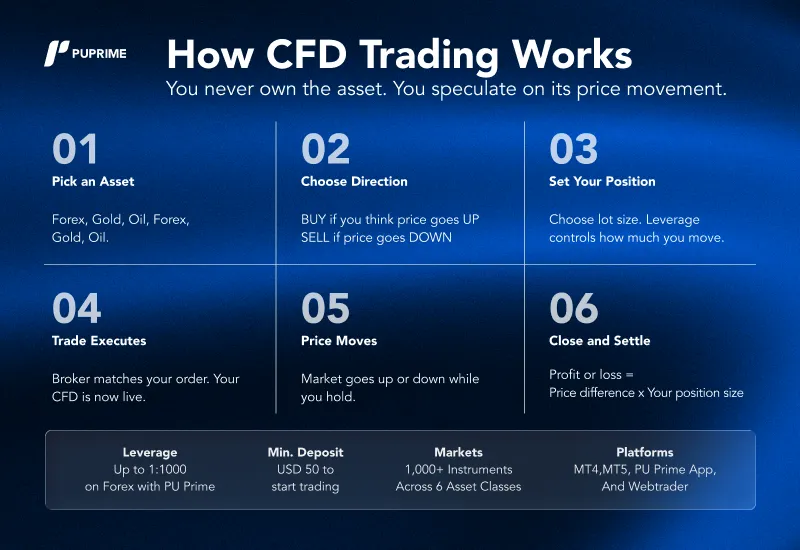
The six step flow of a CFD trade from picking an asset to settlement
What Can You Trade with CFDs?
Most people start CFD trading through forex, which makes sense.
The forex market processes about USD 7.5 trillion per day, making it the largest financial market in the world. But CFDs go far beyond currency pairs.
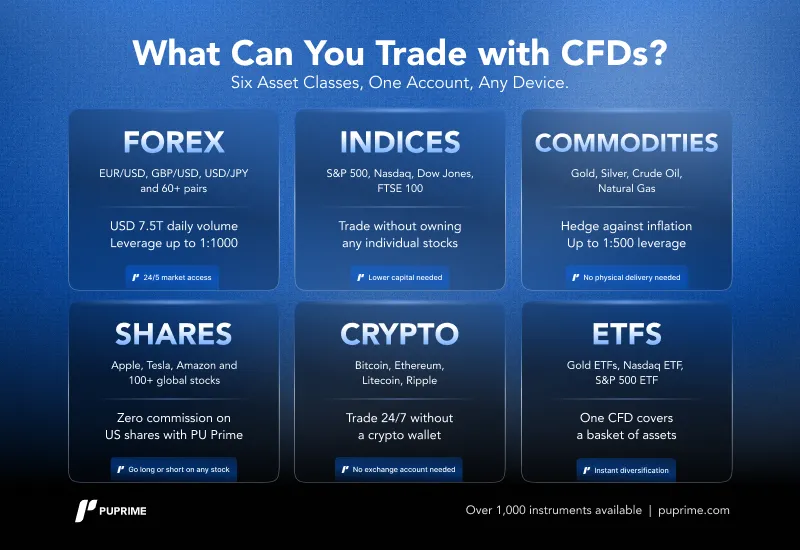
PU Prime gives you access to over 1,000 instruments across six asset classes, all from one account. Here’s what it looks like in practice:
The six CFD asset classes available on PU Prime and their key features
The Key Elements of a CFD
Element
What It Means
Underlying Asset
The market you’re trading in – gold, EUR/USD, the S&P 500, etc.
Direction
BUY (go long) if you think the price rises. SELL (go short) if you think it falls.
Position Size
How many units or lots do you trade? A larger size means larger profit or loss per price move.
Leverage
A multiplier that lets you control a larger position with a smaller deposit (margin).
Spread
The gap between the buy and sell price. This is typically how the broker makes money.
Overnight Swap
A small fee (or credit) if you hold a position past the daily cutoff time.
Each market has its own personality.
Forex is fast and liquid.
Gold tends to move in long trends.
Indices respond to economic data releases.
Shares can gap overnight on company news. Crypto can move 10-20% in a single day.
How CFD Leverage Works (And Why It Matters)
Leverage is what makes CFD trading different from simply buying assets directly. It lets you control a position much larger than your deposit. Here’s a concrete example:
Without Leverage
With 1:100 Leverage
You have USD 1,000
You have USD 1,000
You buy USD 1,000 EUR/USD
You control USD 100,000 of EUR/USD
If the price rises 1%, you make USD 10
If the price rises 1%, you make USD 1,000
If the price falls 1%, you lose USD 10
If the price falls 1%, you lose USD 1,000 – your entire deposit
Leverage magnifies both profits and losses.
A 1% move in the market with 1:100 leverage creates a 100% move in your account balance.
That’s the appeal and the danger of CFD trading.
Most experienced traders use far less than the maximum leverage available.
A common rule of thumb is to never risk more than 1-2% of your account on any single trade.
Most experienced traders use far less than the maximum leverage available, and understanding how CFD margin and leverage work together is what stops leverage from turning a small mistake into a large one.
CFD Trading Costs: What They Are
Before you place a single trade, you should know exactly what it will cost.
CFD costs are not always obvious, and they add up fast.
There are four main ones:
1. The Spread
The spread is the difference between buying and selling prices.
It’s the most common cost in CFD trading, and it’s built into every trade you open.
If EUR/USD is quoted at 1.0850 / 1.0852, the spread is 0.0002 (2 pips).
The smaller the spread, the less the price has to move in your favor before you break even.
PU Prime’s ECN account offers spreads as low as 0.0 pips on forex, though a commission is charged per trade.
2. Overnight Swap Fee
If you hold a CFD position past the daily rollover time (usually 22:00 GMT), you pay or receive a swap fee.
This is linked to the interest-rate differential between the two currencies in a currency pair, or to borrowing costs for other assets.
For long-term traders, overnight swaps can be costly.
For day traders who close all positions before rollover, they’re not a factor.
3. Commission (Account-Dependent)
PU Prime’s Standard and Cent accounts charge no direct commission.
The spread covers the cost.
The Prime and ECN accounts have tighter spreads but charge a small commission per lot traded.
4. Currency Conversion
If you trade an asset priced in a currency different from your account’s base currency, a conversion happens automatically when you close the trade.
Opening your first CFD trade takes less than five steps.
Here’s exactly what that process looks like on PU Prime:
Register an account at puprime.com. The process takes about five minutes. You’ll choose an account type (Standard is fine for beginners) and provide your email address.
Complete identity verification (KYC). Upload a copy of your government-issued ID and proof of address. Regulators require this, and it is usually approved within a few hours.
Fund your account. The minimum deposit is USD 50. PU Prime supports bank transfers, credit cards, e-wallets, and cryptocurrency deposits. No deposit fees apply.
Choose a trading platform. PU Prime supports MetaTrader 4, MetaTrader 5, the PU Prime App, and PU Web Trader. MT4 and MT5 are the industry standards. The PU Prime App is a good choice for mobile trading and offers access to copy trading.
Find your market and place your first trade. In MT4 or MT5, go to the Market Watch panel, find your instrument, right-click, and choose “New Order.” Set your lot size, stop-loss, and take-profit levels before confirming.
Not ready for a live account yet? PU Prime offers a demo account with simulated funds — use it to practise order types and see how different leverage settings affect your balance before you risk real money.
When you are ready, you can open a CFD trading account in about ten minutes.
Use it to practice order types and test how different leverage settings affect your balance before trading with real money.
Not ready for a live account yet? PU Prime offers a demo account with simulated funds — and our step-by-step guide to placing your first CFD trade walks through the whole process from account setup to your first order
Going Short: How to Profit from Falling Markets
One of the things that makes CFDs different from buying stocks directly is the ability to go short.
Short selling means opening a SELL position.
You profit if the price falls. You lose if it rises.
Here’s a simple example: Suppose you think the price of crude oil is about to drop because a large supply report is coming out.
You sell 1 lot of WTI oil at USD 80 per barrel. Oil falls to USD 75. You close the trade.
Your profit is USD 5 x the contract size for oil.
Going short with CFDs does not require borrowing shares or any special setup. You simply choose SELL instead of BUY when you open the order.
This is one reason CFD traders may find opportunities in both bull markets and bear markets.
CFD vs Stocks vs Forex: Key Differences at a Glance
People often ask how CFD trading compares to buying stocks directly or trading spot forex.
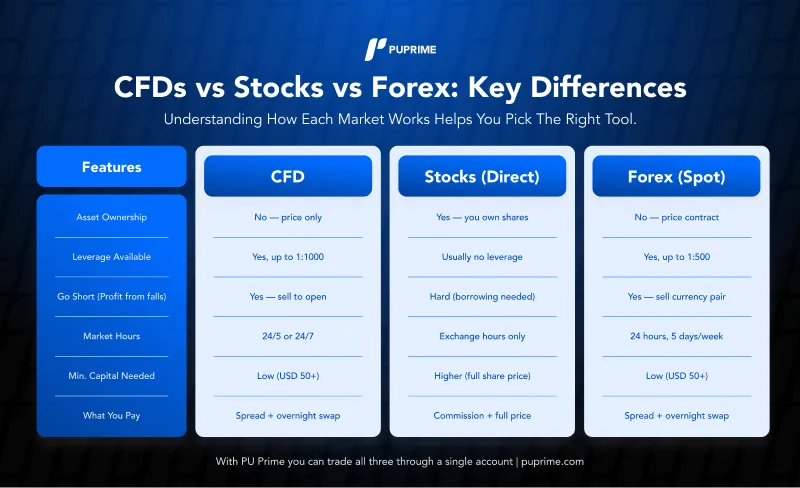
Here’s a quick comparison table, followed by an explanation of when each approach makes sense:
CFDs vs Stocks vs Forex across six key features
The short answer: CFDs suit traders who want flexibility, leverage, and access to multiple markets from one account.
Buying stocks directly suits longer-term investors who want ownership and dividend rights.
Spot forex is actually structured as a CFD at most retail brokers, including PU Prime.
CFDs suit traders who want flexibility and access to multiple markets, while buying stocks directly suits longer-term investors who want ownership — a difference we cover fully in CFD vs stock trading.
The right approach depends on how much time you can give to trading, your risk tolerance, and which markets you prefer.
Here’s a quick overview of the most common styles
Strategy
Time Frame
Risk Level
What It Involves
Day Trading
Minutes to hours
Medium-High
Open and close all positions within a single trading day.
Swing Trading
2-7 days
Medium
Hold trades for several days, aiming to capture short-term price swings.
Trend Following
Days to weeks
Medium
Trade in line with an established market trend.
Scalping
Seconds to minutes
High
Make many small trades, each targeting a few pips of profit.
Position Trading
Weeks to months
Lower
Hold larger trends based on fundamental analysis.
Whatever strategy you use, back-test it on a demo account before risking real money, and think carefully about diversification across a leveraged portfolio rather than concentrating risk in one position.
Whatever strategy you use, back-test it on a demo account before risking real money.
CFD Risk Management: The Basics You Cannot Skip
This section exists for one reason: more people lose money in CFD trading than make it.
Regulatory disclosures consistently show that 70-80% of retail CFD accounts lose money.
That’s not a scary tactic.
It’s a fact published by regulated brokers because authorities require disclosure.
People in the 20-30% who are profitable almost all share one habit: they take risk management seriously before they care about strategy.
Here are the five rules that matter most:
Never risk more than 1-2% of your account on a single trade. If you have USD 1,000, that’s USD 10-20 per trade. It feels small, but it keeps you in the game after losing streaks.
Use a stop-loss on every single trade. A stop-loss closes your trade automatically at a set price, so your loss cannot grow beyond your plan.
Match your leverage to your experience. High leverage is not a shortcut to bigger profits. It’s a shortcut to bigger losses until your strategy is proven.
Never trade money you cannot afford to lose. CFDs are not a savings vehicle or an income replacement. They’re a high-risk speculative instrument.
Keep a trading journal. Write down why you entered every trade and what happened. After 20-30 trades, the patterns in your mistakes will be obvious.
CFD trading suits people who want active exposure to financial markets and are comfortable with the risk to their capital.
It does not suit people looking for a passive investment or a guaranteed return.
You might be a good fit for CFD trading if:
You have time to monitor positions (or use stop-losses to protect them when you’re away).
You can afford to lose the money you deposit.
You’re willing to learn before you trade significant size.
You’re interested in multiple markets, not just one asset class.
CFD trading is probably not right for you if:
You’re looking for safe, low-risk returns on savings.
You don’t have time to understand what you’re trading.
You’re planning to trade with money you need for bills or living expenses.
CFD trading rewards discipline and punishes impulsiveness, so before you decide, it’s worth an honest look at the pros and cons of CFD trading with clear eyes.
We can’t emphasize this more.
Frequently Asked Questions
What is CFD trading in simple terms?
CFD trading is when you agree with a broker to exchange the price difference of an asset, like gold or a currency pair, between when you open a trade and when you close it.
You never own the asset.
You bet on whether the price goes up or down.
If you’re right, you profit. If you’re wrong, you lose.
How much money do I need to start CFD trading?
With PU Prime, the minimum deposit is USD 50.
However, USD 200-500 gives you more flexibility to manage risk properly, because you can keep your position sizes small relative to your balance.
Never deposit more than you can afford to lose entirely.
Can you make a living from CFD trading?
A small number of professional traders do make a living from CFDs, but they are a minority.
Regulatory disclosures from CFD brokers consistently show that 70-80% of retail CFD accounts lose money.
Most people who try to trade full-time for income run into problems with inconsistency and emotional decision-making.
Treating CFDs as a speculative sideline rather than a primary source of income is the more realistic starting point.
Is CFD trading legal?
CFD trading is legal in most countries outside the US.
It is regulated in the UK (FCA), Australia (ASIC), Europe (CySEC and others), and many other jurisdictions.
In the US, retail CFDs are not legal. PU Prime is regulated by the Financial Services Authority of Seychelles (FSA, License SD050) and the Australian Securities and Investments Commission (ASIC, License 410681).
Other than that, the Financial Services Commission of Mauritius (FSC), the Financial Sector Conduct Authority of South Africa (FSCA), and the Capital Market Authority of the UAE (CMA)
What is the difference between a CFD and a real stock?
When you buy real stock, you own a share of that company.
You can receive dividends and vote at shareholder meetings.
When you trade a CFD on that stock, you own nothing.
You speculate only on the price.
CFDs offer leverage and the ability to go short, which direct share ownership does not.
In some jurisdictions, CFD profits are treated as capital gains.
In others, they are treated as income. We are not tax advisors. Consult a qualified tax professional in your country before making decisions based on CFD tax treatment.
What happens if the market moves against me more than my balance?
PU Prime provides negative balance protection.
This means your account cannot go below zero.
If a trade moves against you faster than a stop-loss can trigger (for example, during a gap in the market), the broker absorbs the excess loss beyond your account balance.
You cannot owe your broker money.
Can I use a demo account to learn CFD trading?
Yes. PU Prime offers a demo account with simulated funds.
It uses live market prices, so the spread and price movements are real.
You just do not risk actual money.
A demo account is the best way to learn order placement, test strategies, and understand how leverage affects your balance before going live.
What is the overnight swap fee in CFD trading?
An overnight swap is a small fee (or credit) charged when you hold a CFD position past the daily rollover time, which is usually 22:00 GMT.
The fee is based on the interest rate differential between the two currencies in a pair, or on the cost of borrowing the underlying asset in other markets.
For short-term traders who close positions the same day, overnight swaps are not a factor.
What platforms can I use to trade CFDs on PU Prime?
PU Prime supports MetaTrader 4 (MT4), MetaTrader 5 (MT5), PU Web Trader, and the PU Prime mobile app. MT4 and MT5 are industry-standard platforms with full charting, automated trading (Expert Advisors), and a large community.
The PU Prime App also includes the copy trading feature, which lets you automatically replicate trades from experienced signal providers.
This content is for educational and informational purposes only and should not be considered investment advice, a personal recommendation, or an offer to buy or sell any financial instruments.
This material has been prepared without considering any individual investment objectives, financial situations. Any references to past performance of a financial instrument, index, or investment product are not indicative of future results.
PU Prime makes no representation as to the accuracy or completeness of this content and accepts no liability for any loss or damage arising from reliance on the information provided. Trading involves risk, and you should carefully consider your investment objectives and risk tolerance before making any trading decisions. Never invest more than you can afford to lose.
Start trading with an edge today
Trade forex, indices, metal, and more at industry-low spreads and lightning-fast execution.
Start trading with deposits as low as $50 on our standard accounts.
Get access to 24/7 support.
Access hundreds of instruments, free educational tools, and some of the best promotions around.
Important Notice: Please note the Website is intended for individuals residing in jurisdictions where accessing the Website is permitted by law.
Please note that PU Prime and its affiliated entities are neither established nor operating in your home jurisdiction.
By clicking the "Acknowledge" button, you confirm that you are entering this website solely on your own initiative and not as a result of any specific marketing outreach. You wish to obtain information from this website which is provided on a reverse solicitation basis in accordance with the laws of your home jurisdiction.
Please note the Website is intended for individuals residing in jurisdictions where accessing the Website is permitted by law.
Please note that PU Prime and its affiliated entities are neither established nor operating in your home jurisdiction.
By clicking the "Acknowledge" button, you confirm that you are entering this website solely based on your initiative and not as a result of any specific marketing outreach. You wish to obtain information from this website which is provided on reverse solicitation in accordance with the laws of your home jurisdiction.
Ten en cuenta que el sitio web está destinado a personas que residen en jurisdicciones donde el acceso al sitio web está permitido por la ley.
Ten en cuenta que PU Prime y sus entidades afiliadas no están establecidas ni operan en tu jurisdicción de origen.
Al hacer clic en el botón "Aceptar", confirmas que estás ingresando a este sitio web por tu propia iniciativa y no como resultado de ningún esfuerzo de marketing específico. Deseas obtener información de este sitio web que se proporciona mediante solicitud inversa de acuerdo con las leyes de tu jurisdicción de origen.